
Knox Projected Versus Actual Release
A projected date is a scheduled or calculated point. It is not a record of completed physical exit. In Knox County, KCSO may display DUE OUT TIME on a live custody entry. TDOC's statewide FOIL system may display Release Eligibility Date, commonly called RED, along with Sentence End Date and parole fields. These labels answer different questions. Due-out is a local scheduled event. RED is the earliest point at which an eligible state sentence may receive parole consideration. Sentence End Date describes the state sentence framework.
Actual release is retrospective. A KCSO release sheet, TDOC release authorization, or source-fed VINELink release event can establish that the named agency's custody ended. Even then, destination matters. Transfer to TDOC, another jail, ICE, or federal custody is not community release. A parole grant also falls short of exit because program completion, an approved plan, certificate work, detainer review, and physical processing may remain.
DUE OUT TIME, Release Eligibility Date, Sentence End Date, hearing date, and actual release separately.Pretrial custody has another rule. A person awaiting case disposition does not have a computed sentence-release date. Bond or dismissal can authorize release, yet another case, warrant, detainer, or processing step may keep the person in custody. The court order explains the legal authority. KCSO confirms whether the release was carried out.
Find Knox County Release Dates
Begin with the custodian and sentence type. The Knox County Sheriff's Office tracks county jail custody. TDOC tracks state felony confinement and supervision. A Knox arrest does not by itself mean TDOC received the person, and a Knox conviction may later place the person in a state prison outside the county. The source must match the stage.
- Check the KCSO current population for a recent county stay. A positive match shows current county custody as of that display; absence alone does not prove release.
- Read any KCSO
DUE OUT TIMEonly as scheduled. After it passes, verify with KCSO, VINELink, and the retained release record. - For a state felony offender, open the TDOC FOIL search. Search by exact TDOC/TOMIS or SID when available, or use name fields and the case-sensitive CAPTCHA.
- Compare date of birth and identifiers. Then read Supervision Status, Assigned Location, active sentences, RED, Sentence End Date, and parole fields together.
- Check the Knox judgment for sentence, jail credit, consecutive cases, probation, and later orders. Seek the official computation if the public fields conflict.
- After a prospective date passes, obtain a positive release event or actual release record rather than assuming the person left.
The broader Knox County released inmate records path explains how KCSO, the court, FOIL, and federal systems divide responsibility. For a projected date, keep the inquiry narrow: what is the exact field label, which agency calculated it, and has an actual custody-ending event occurred?
Note: Record the field label, source agency, and access time because Tennessee sentence fields may change as new court documents arrive.
Knox FOIL Release Date Fields
FOIL is Tennessee's released-first felony tool because it includes people currently or formerly in TDOC custody or supervision. Search fields include last and first name, optional aliases and race, exact TDOC/TOMIS ID, and State ID or SID. The result may show a photo, identifiers, physical descriptors, Supervision Status, Assigned Location, sentence length, supervision or custody level, Sentence Begin Date, Sentence End Date, RED, parole hearing information, and active Tennessee sentences.
| FOIL field | How to read it |
|---|---|
| Supervision Status | Distinguishes incarceration, parole, probation, and inactive state status. |
| Assigned Location | May identify a prison or community-supervision office; it cannot be read alone. |
| Release Eligibility Date | Earliest parole consideration under the official computation, not an exit appointment. |
| Sentence End Date | Sentence-expiration framework, subject to controlling records and later changes. |
| Parole Hearing Date/Result | Board process information; even a grant does not prove physical release. |
| Active Tennessee Sentences | Shows conviction information that may control the calculation or reveal more than one term. |
The official FOIL field-help page is the source for the terminology shown in this captured reference.
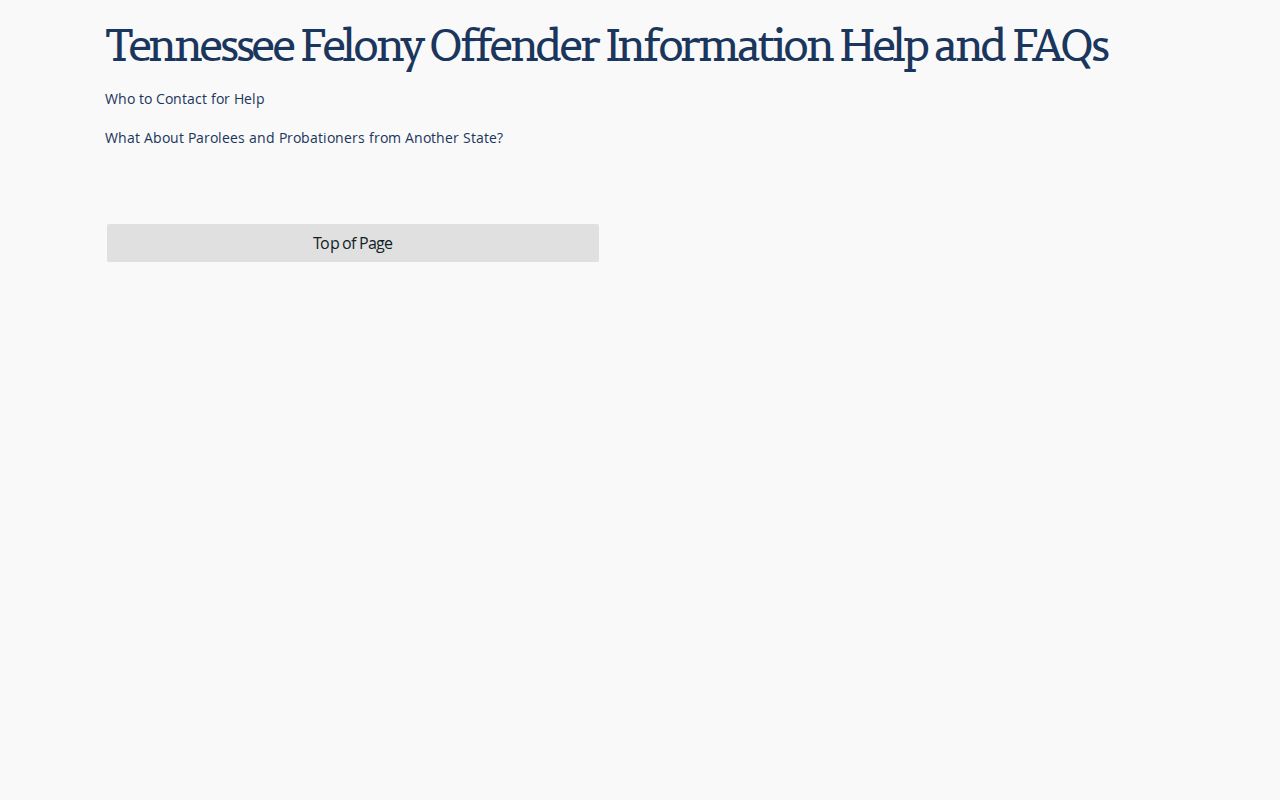
The official help reinforces why RED, sentence end, parole result, and current status should be read as a set rather than collapsed into one projected date.
A former offender may appear as Inactive with no active sentence rather than with a universal field labeled Actual Release Date. When exact physical date, method, or destination matters, request TDOC's release authorization or certificate, sentence calculation, discharge or expiration record, and movement history.
Tennessee Credits Shape Knox Release
Tennessee has no single subtraction rule that safely converts every sentence into a release date. Under TCA § 40-35-501, RED depends on sentencing range, offense rules, offense date, and applicable credits. General range percentages can include 20 or 30 percent for especially mitigated terms, 30 percent for Range I, 35 percent for Range II, 45 percent for Range III, and 60 percent for career classifications where the governing subsection applies. Consecutive ineligibility periods can also be added.
TCA § 41-21-236 authorizes up to sixteen sentence-credit days per month, with up to eight for good institutional behavior and eight for satisfactory program performance. For qualifying offenses committed on or after July 1, 2024 with terms over two years, credits can affect time to parole eligibility without changing sentence expiration. Earlier offenses and shorter terms can operate differently. For offenses on or after January 1, 1988, credits generally cannot cut the time to earliest RED by more than thirty percent.
The current Tennessee parole-eligibility statute appears in the source image below.
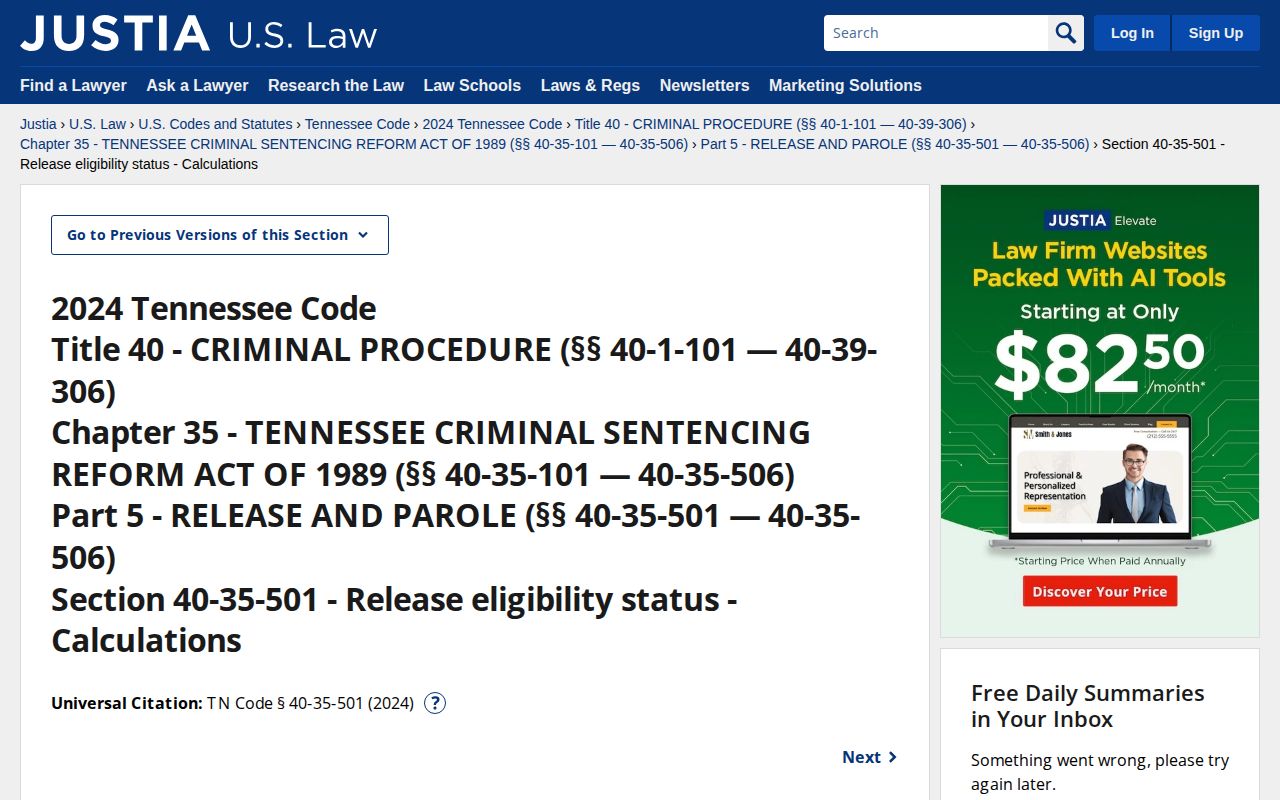
This statutory text is a framework, not a personal sentence calculator. The judgment and official TDOC timekeeper record still control the individual computation.
Note: Use the offense date, not the arrest, conviction, or search date, when identifying the governing Tennessee sentencing provision.
Knox Release Has No Universal 85%
The familiar “serve 85 percent” phrase is not a statewide answer. Section 40-35-501(y) places an 85-percent baseline on listed offenses committed from July 1, 2021 through June 30, 2024, with credits unable to reduce service below 70 percent. For listed offenses committed on or after July 1, 2024, the 85-percent amount is undiminished for expiration, while credits of up to fifteen percentage points affect parole eligibility instead of expiration.
Other subsections contain 100-percent or no-release-eligibility categories, and older rules use offense-specific percentage schemes. The correct result needs the precise offense, offense date, range, judgment, consecutive or concurrent treatment, jail credit, and earned-credit history. A public calculator that applies one percentage can turn a legal threshold into a false release promise.
- Release Eligibility Date
- The earliest statutory point for parole consideration under TDOC's computation.
- Sentence End Date
- The stated end of the sentence framework, not always the day of physical exit.
- Parole
- Conditional community release before sentence expiration under Board authority.
- Detainer
- A hold or request by another authority that can change the next custody step.
What Changes Knox Release Dates
Prospective dates move for reasons that may never be visible in one public field. TDOC warns that dates can change as court documents arrive. Knox County custody can also involve several documents, charges, and court divisions. Time served on one case does not clear another warrant or hold. KCSO must receive and process the controlling order before it can complete discharge.
| Factor | Possible effect | Best confirming source |
|---|---|---|
| Amended judgment or jail credit | Changes the official sentence calculation. | Court judgment and TDOC or KCSO timekeeper record. |
| Consecutive sentences | Adds controlling periods before eligibility or expiration. | Active sentences, judgments, and certified computation. |
| Credit award or loss | Moves parole eligibility where the statute permits. | TDOC sentence calculation and disciplinary record. |
| Detainer, warrant, or another case | Can block community exit or cause a transfer. | KCSO, court, and receiving agency. |
| Parole denial or conditions | Continues confinement or delays release after a grant. | Board action, FOIL, and release certificate. |
| Late court documents | Causes FOIL dates to be recalculated. | TDOC official timekeeper record. |
No public KCSO policy located in the official sweep states a standard county good-time amount, Friday adjustment, fixed weekend-release practice, or daily release hour. Those details should not be guessed. For a county term, obtain the judgment and ask KCSO or the court about the named case.
Knox Due-Out Versus RED
Knox exposes an unusual pair of prospective labels across two systems. KCSO's live pages can show DUE OUT TIME. Tennessee FOIL shows Release Eligibility Date. The first is a scheduled local event in county custody. The second is an eligibility point calculated for a state sentence. Neither field records the moment a person cleared the exit process.
A third stage can appear through the Board of Parole. Hearing schedules are requested by email and refreshed weekly, and FOIL can show a hearing date or result. A scheduled hearing is not a decision. A parole grant is not physical release. Conditions, a plan, certificate work, required programs, and detainer checks can stand between the grant and exit.
The useful sequence is scheduled, eligible, heard, granted or denied, authorized, and actually released. Keep every step under its source label. That approach prevents a Knox due-out time, TDOC RED, or Board action from being reported as more final than it is.
Note: After any prospective Knox release date passes, seek a positive status change or source release record before describing release as complete.
Confirm Knox Actual Release Dates
For county custody, call Roger D. Wilson Detention Facility at 865-281-6700 or Knox County Jail at 865-342-9620 with the name, date of birth, IDN, and facility. Ask whether KCSO still holds the person. If not, ask whether KCSO can confirm the actual date and time and distinguish community release from transfer. Written proof can be requested from KCSO Records at 400 West Main Street, Knoxville, phone 865-215-2243.
For state custody, FOIL supplies the public status and sentence framework. TDOC archived records can provide a release authorization, certificate, official calculation, sentence-expiration or discharge record, and movement history. The Tennessee Board of Parole owns parole actions, while TDOC remains the timekeeper. A dispute about calculation needs a certified court or TDOC record, not personal arithmetic from a public screen.
A pending county or state event can also be followed through the Knox County VINELink check. Register before the event, read release and transfer alerts separately, and confirm the source record when the exact time or method matters.