
Knox County Parole and Probation
Parole and probation both allow a person to be in the community under rules, but they begin in different ways. Parole is conditional release from a prison sentence. The Tennessee Board of Parole decides whether an eligible incarcerated person may leave confinement, while the Tennessee Department of Correction, or TDOC, manages the sentence and field supervision. Probation is ordered by a court, often instead of prison or after a split sentence. The sentencing court remains central to probation orders, warrants, and revocation actions.
A public record may use other terms. Community corrections is a court-based alternative with close controls. Mandatory reentry supervision may place a qualifying person under parole-like oversight near the end of a sentence. Determinate release also has its own statutory framework. The judgment, offense date, and active sentence control the result, so a broad label should not replace the source record.
| Point | Parole | Probation |
|---|---|---|
| How it starts | Board-approved conditional release from confinement | Court-ordered community supervision |
| Public verification | FOIL status, assigned office, and Board records | FOIL when TDOC supervises, plus the Knox court file |
| Violation authority | Board warrant and revocation process | Sentencing court warrant and revocation process |
| Completion | Discharge or sentence expiration shown by the controlling record | Court or TDOC completion and discharge record |
Knox Supervision Terms Defined
Status words matter because they answer different questions. A released person can be outside a jail yet remain subject to state rules. A record that says the person is no longer at Roger D. Wilson also does not prove that parole or probation has ended.
- Parole
- Conditional community release during a prison sentence, governed by Board and TDOC rules.
- Probation
- A court-ordered term served in the community under stated conditions.
- Absconded
- A status indicating failure to report to supervision, not successful discharge and not proof of current physical custody.
- Discharge
- The formal end of the controlling custody or supervision term.
- Detainer
- A request or hold from another authority that may affect custody or release.
FOIL should be read as a set of fields. “Inactive” generally points toward no active TDOC supervision. “Parole” or “Probation” indicates community supervision. “Incarcerated” means the person has not been released from state confinement, and “Absconded” describes a supervision problem rather than a clean end to the sentence.
Note: An assigned Knoxville office supports a Knox-area supervision link, but the field office should confirm whether that assignment remains current.
Verify Knox County Post-Release Supervision
The official statewide starting point is the TDOC Felony Offender Information Lookup. FOIL covers people currently or formerly in TDOC custody or supervision. It does not cover every Knox County misdemeanor case, juvenile matter, federal sentence, or immigration case. Search by a precise state identifier when possible, since common names can return more than one person.
- Search FOIL by exact TDOC or TOMIS ID, SID, or by last and first name. Optional aliases and race can refine or broaden the result.
- Match the date of birth, state identifiers, aliases, and other descriptors before selecting a record. A photograph alone is not enough.
- Read Supervision Status with Assigned Location, Sentence End Date, active sentences, and parole fields. No single field supplies the whole answer.
- If District 20 appears, contact the Knoxville office and ask whether the public district and supervision category are current. Do not request a protected home address.
- For probation questions that FOIL does not settle, examine the Knox sentencing court record for the probation order, revocation action, and completion entry.
The Knox Criminal Court Clerk keeps Criminal Court, General Sessions Criminal, and Fourth Circuit records. A judgment or probation order explains the legal term. It may not show the latest physical custody event, so pair it with the correct jail, TDOC, or notification record. The broader Knox County released-inmate search path explains how those sources fit together.
Knox County District 20 Supervision
Knox County falls within TDOC community-supervision District 20. The official TDOC field-office directory is the source for the Knoxville office. Its public listing gives the office address and phone, while FOIL may name the same district as an assigned location. Staff can confirm the public category and office assignment, subject to privacy and safety limits.
TDOC District 20
1426 Elm StreetKnoxville, TN 37921
Phone: 865-582-2000
Fax: 865-594-7105 or 865-594-7125
Have the full name, date of birth, and TDOC or TOMIS number ready. Ask whether the displayed supervision type and district are current. Public staff may not disclose a home address, treatment detail, safety plan, or other protected data. A limited answer is not evidence that supervision ended.
The directory view below shows the official source used to locate District 20. The TDOC field-office directory should be checked again before a visit or call.
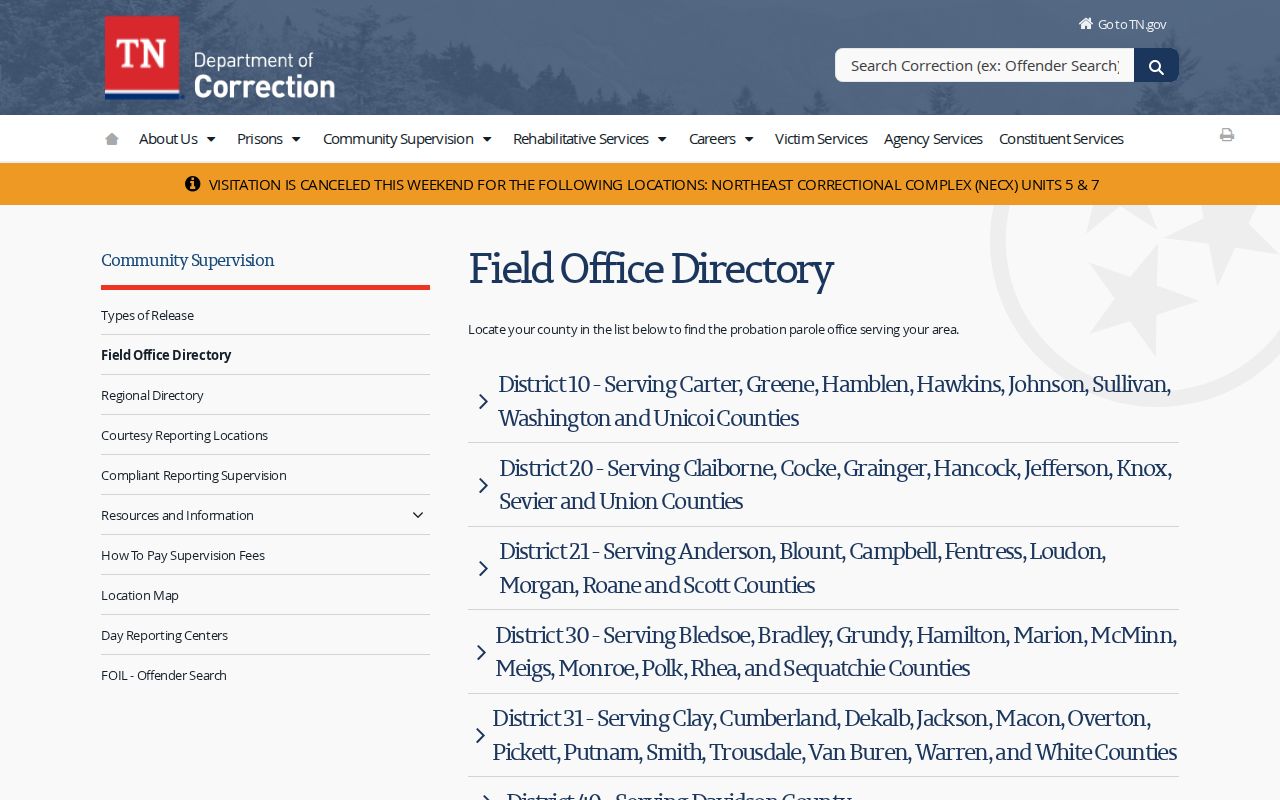
This directory connects a FOIL assigned-location field to the proper Knoxville supervision office instead of treating the location as a jail.
Confirm Knox Release at District 20
A District 20 assignment is a useful Knox County detail, but it must be interpreted with the status. If FOIL says parole or probation and lists the Knoxville district, the record supports community supervision in the area. It does not provide a protected residence, a daily schedule, or proof that no other case exists. Direct confirmation should stay narrow: identity, public supervision category, and whether District 20 remains the assigned office.
When a former KCSO detainee later appears under District 20, first determine whether TDOC actually supervised the sentence. A county arrest by itself does not create a TDOC record. Conversely, a Knox felony case may lead to state custody outside the county and later return to local field supervision. That sequence is state release to supervision, not a county-jail release record.
Note: District 20 is a community-supervision office, not a detention center, and an office assignment does not show where someone lives.
Knox County Supervision Violations
No separate official statewide TDOC public absconder list was found in the Knox research sweep. FOIL may show “Absconded.” That word means a person failed to report to parole, probation, or community corrections. It does not mean the term ended. It also does not prove where the person is now or whether an arrest has occurred.
Authority depends on the supervision type. The Tennessee Board of Parole handles parole warrants and revocation decisions. A sentencing court handles probation warrants and status. A final revocation may return a person to custody, while another ruling may reinstate supervision. VINELink can report custody events from a participating agency, but it is not a public warrant database and should not be used to infer a violation from silence.
Conditions differ by judgment and release certificate. Common high-level duties can include reporting, obeying laws, completing ordered programs, and following travel or contact terms, but the exact rules must come from the person’s official order. Do not assume a standard Knox County condition. Obtain the order or action sheet if the legal scope matters.
Knox Reentry After Supervised Release
TDOC states that Community Resource Center services are available to people on community supervision and to people released after sentence expiration. That makes the Knoxville Community Resource and Day Reporting presence a post-release navigation point, not a custody site. The TDOC Community Resource Center page describes the statewide role.
A TDOC notice from 2023 placed the Knoxville center at 8417 Kingston Pike and listed 865-403-1636. Because that local notice is dated, verify the address and phone through TDOC before relying on them. The source image below documents the local resource-fair contact, not a current detention location or a promise of service.
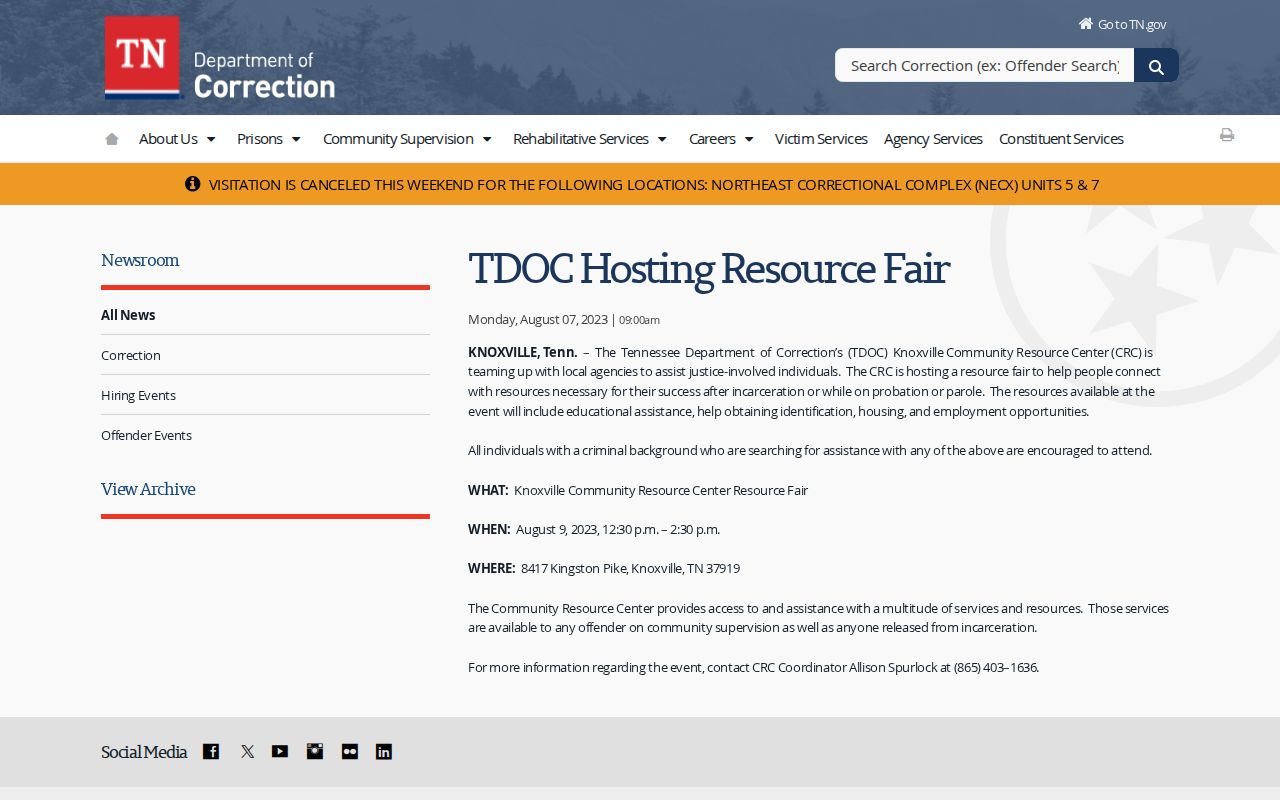
The center may help people navigate services after release, while District 20 remains the proper office for public supervision-assignment questions.
Property After Knox County Release
Supervision records do not settle jail property or inmate-account issues. KCSO separately explains what happens when someone leaves county custody. Released inmates receive a debit card for the balance in the inmate money account. If the card or funds are not ready at release, the funds may be picked up at Roger D. Wilson Detention Facility. KCSO says unclaimed money transfers to Tennessee as unclaimed funds after one year.
The KCSO corrections FAQ also separates property from money release. Personal property may be released around the clock. Money release occurs only during normal weekday business hours and requires a Property Transfer Receipt. These practical rules do not state a release hour, supervision term, or custody status. They simply route a released person or authorized recipient to the right KCSO process.
Knox County Supervision Discharge Records
Supervision ends through the controlling legal process, not because a name disappears from one screen. FOIL may become inactive and show no active Tennessee sentence, but an exact end date or method may require a TDOC discharge or expiration record. Request the release authorization or certificate, sentence computation, discharge record, and relevant movement history when a formal record is needed.
TDOC archived requests go through its archived offender-record process. Supply the offender name, TOMIS number, date of birth, contact details, and a precise description of the record. Archive fees may apply, and TDOC sends notice before charges. A Knox probation matter may instead end through a court entry, so request the completion or discharge entry from the clerk that handled the case.
A discharge record addresses the state supervision term. It does not rule out a new case, a federal term, or another jurisdiction. Use time-stamped wording such as “FOIL listed the status as inactive when checked” until the underlying record confirms the exact end of supervision.